

_edited.png)
NATO: A United Alliance?
- Ben Whitehead
- Nov 20, 2023
- 3 min read

When Russian President Vladimir Putin claimed in 2017 that it would help Russia if NATO were falling apart, there did seem to be a now known to be false illusion that the alliance was in major trouble from the likes of US President Donald Trump. Now, on the flip side, it seems stronger than ever. The first few chaotic hours of the Russian Invasion of Ukraine, news reports widely did seem to portray all hope being lost. There was a clear precedent set that NATO would “collapse” and the West would “fall”. However, it clearly seemed, with the defeat of Russian forces around the Northern areas of Ukraine, and their subsequent withdrawal, that NATO seems back on the precedent of a united alliance.
An example of the new demonstration of unity throughout the North Atlantic Treaty Organisation is the recent admission of Finland (and soon, Sweden) into the alliance. Finland has historically remained a relatively neutral country, throughout the Cold War, although the Soviets did have a policy named Finlandisation that was signed in 1948. This gave Finland the permission to remain neutral from the USSR, and it was, mainly respected. By 1994 Sweden and Finland had both become NATO partners and after the Russian Federation invaded Ukraine in February 2022, the process of accession was hastily completed by the country. However, there were a few issues regarding Turkey. Finland and Sweden have been loyal supporters of the Kurds' fight for independence, and this is something that the Turkish Erdogan government was not pleased about. The subsequent delays led to serious amounts of political manoeuvring (rumoured to be the sale of US F-16 Fighters to Turkey) and eventually Finland was allowed to join in April 2023. Sweden is expected to follow suit very soon. However, the vast majority of NATO members were more than happy to approve Finland and Sweden’s accession into NATO. This shows that there is a clear sense of unity within the alliance and that collective defence is a priority.
Similarly, the creation of new Battlegroups and the activation of the NATO response force on February 25th 2022, the day after the invasion of Ukraine, shows that NATO is still a strong powerful force that was immediately able to deploy large amounts of troops onto its Eastern flank, specifically Poland and Romania. Similarly, the Enhanced Forward Presence for Eastern Europe has highlighted the unity between NATO states, with mass numbers of foreign troops being deployed onto their soil. A good example of this is Estonia. Estonia is the furthest North of the three small Baltic states and has a large presence of NATO troops. Led by the UK, there were, for example, RAF and Luftwaffe Eurofighter Typhoons leading a NATO Air Policing mission in the country. This suggests that the Alliance is more than happy to provide collective defence for their less powerful alliance members. RAF Chinook and Army Air Corps Wildcats were also deployed during Exercise Spring Storm. This highlights another capability, which is the capability to deploy forces rapidly, something NATO has arguably clearly been working on since its formation, and now too.

Pictured is an RAF Eurofighter Typhoon FGR4 intercepting Russian Aircraft as part of NATO's Baltic Air Policing
Another area in which unity is clear is in the ability to share aircraft fleets and crews between member states. NATO operates a Strategic Airlift Capability, with 3 Boeing C-17 Globemaster II heavy strategic transport aircraft. These aircraft can be requested by NATO members, the EU or the UN and can be put to use for a variety of tasks. Similarly, NATO operates a fleet of 14 E-3 Sentry AWACS aircraft, which have consistently been patrolling the skies near Ukraine for example, likely to be providing Command and Control support and Airborne Early Warning support to the Zelenskyy government. These are crewed by a variety of service personnel from many different alliance states, and this shows clearly that the alliance is willing to work together to achieve coll
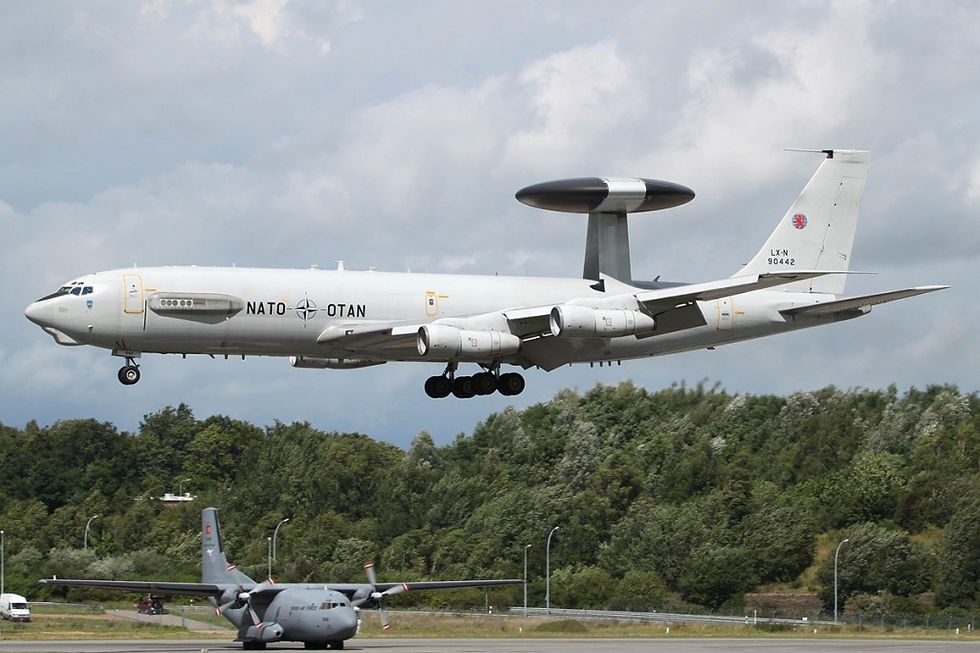
NATO Boeing E-3 Sentry AWACS aircraft
To conclude, it is clear that NATO is a united force, ready to meet any adversary with strength and although there were elements of trouble between Finland/Sweden and Turkey, overall the alliance is united and will continue to support the collective defence of the alliance’s members.
Ben Whitehead is an A-Level Geography, History and Politics student and hopes to pursure a career in the Royal Navy.


Comments