

_edited.png)
Armenia, Azerbaijan and the Nagorno-Karabakh; Counting the Costs and Causes
- Thomas N

- Dec 5, 2023
- 3 min read
Armenia and Azerbaijan have, as of the past few decades, had a relationship that can be described as uneasy at best. With several armed disputes, particularly surrounding the Nagorno-Karabakh region between the two states, Armenia has traditionally come out on top - until recently. But the question is not what is happening now; rather, the question you should ask is where did it all begin? To this end I will explore the origins of the Nagorno-Karabakh conflict and how Armenia and Azerbaijan got to the point that they are in today.
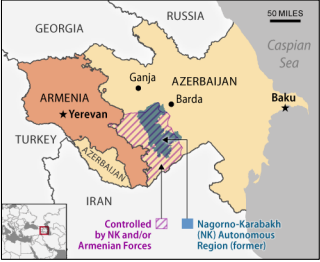
The map on the left displays the state of the Nagorno-Karabakh but also highlights the precise size and location of the region. One-thousand six hundred and ninety nine square miles of decades-long division between two fairly obscure states - but this division is not just drawn on a desire to map-paint. The division runs through history and - especially so - ethnicity.
According to a 1989 census, the Nagorno-Karabakh population was 77% Armenian; this is reflected in scholarly texts made as far back as the 19th Century, which claim that the region was primarily made up of Armenians. This is not dissimilar to Kosovo (~90% Albanian population) and the divide between Albania and Serbia, where the divide of ethnicity has been oftentimes boiled down to the surnames of those living there. Both Albanians and Serbians claim to own the land - and so we begin to see a striking similarity between the Kosovo and Nagorno-Karabakh crises.
As far back as the 11th Century A.D Armenians have made up a vast majority of the population in the region, owing to the vast migration of Turkic peoples and the oppression they then imposed on indigenous Armenians. From then on, estimates claim that the Nagorno-Karabakh was made up of as many as 95% Armenians. However, if we judge a state's claim to land by the ethnic groups within then one might find it hard to argue against the annexation of the Sudetenland in 1938. However, the circumstances are different here - likely because the Armenian government has not ordered up the mass genocide of Armenians nationwide and seek to retain the Karabakh as one of their ethnic territories - not for the right of conquest by any means.
The Azeri claim to the land is one of strategic importance; the region's terrain acts as a natural defence for one which, to live without would theoretically place their sovereignty in jeopardy. They also claim that the Karabakh has historically been a part of Azerbaijan - based on the fact that under Russian control, it was part of the Elisavetpol province which connects to lands now part of modern-day Azerbaijan. Armenia disputes these claims accordingly - citing that the mountains in question are part of the Armenian plateau and stress that the strategic importance to Azerbaijan exists to Armenia as well.

The First World War saw conflict come to the Karabakh - and saw great tragedy for ethnic Armenians across the Ottoman Caucasus. The Armenian Genocide of 1915 executed by Ottoman authorities saw over a million Armenians die and many more displaced; and immediately after the First World War, the first great struggle for the region began. The states of Armenia and Azerbaijan, now free from Ottoman and Russian rule as both empires had been dissolved by 1918, began squabbling over the Karabakh territory until 1920 when they both became part of the Soviet Union.
Under Soviet rule, the Karabakh had been transformed into an autonomous Azeri province - which the Armenians claim began a ruthless campaign of violence and intimidation in a bid to force ethnic Armenians out of the land. This would last from 1920 on their incorporation into the USSR until 1988 - when the Armenians of the land petitioned their government for freedom from Azeri oppression. Mikhail Gorbachev is attributed with spurring this wind of change with his flagship policies of freedom and openness. In light of this, however, the Azeri authorities in the region raised their campaign of oppression against Armenians in the region until 1991. The dissolution of the USSR in 1991 brought the first armed conflict between Armenia and Azerbaijan until a ceasefire was signed in 1994. Around twenty-thousand deaths and over a million displaced people are recorded, and the Nagorno-Karabakh was left firmly in Armenian hands. Five-hundred thousand Azeri people were displaced from other territories around the Karabakh in light of this.
These have been the most basic principles that which the Nagorno-Karabakh conflict are derived from. However, the history of the region goes as far back as the 4th Century and conflict there still carries on in modern times. Expect more articles in future on the modern day situation between Armenia and Azerbaijan, and how Azerbaijan has taken the momentum from Armenia in the region. Thank you for reading.


Interesting Article, It will be interesting to see how long the current ceasefire lasts and whether there will be an outbreak of more fighting, as seen only a few months ago.